Sandstone Swirl

Mason O'Donnell
| 30-04-2026

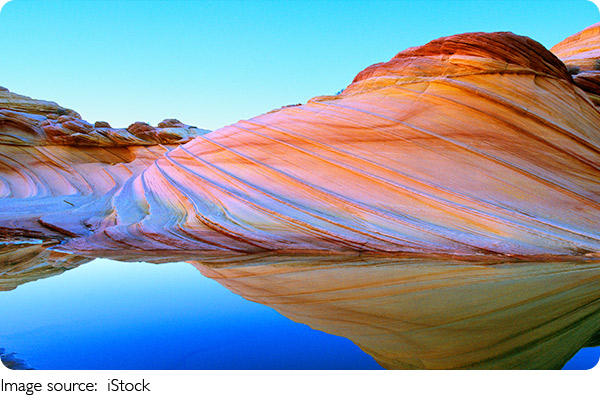
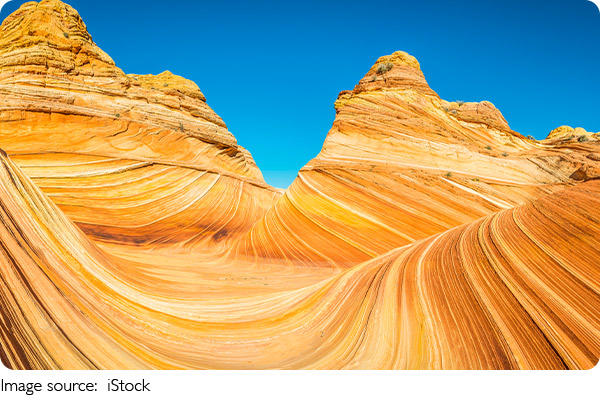
The rock looks like it's moving. Those long, sweeping lines of orange and pink sandstone curl and flow across the surface like frozen ocean waves, and when a thin sheet of rainwater collects in the natural basin at the base, the whole thing doubles — rock above, perfect mirror reflection below, sky wrapping around both sides.
This is The Wave, tucked inside the Vermilion Cliffs National Monument on the Arizona-Utah border, and it is genuinely one of the most visually stunning pieces of geology on the planet.
How Did It Form?
The Wave is made of Navajo sandstone, deposited as desert sand dunes around 190 million years ago. Over time, those dunes were buried, compressed into rock, then slowly exposed again by erosion. The swirling lines you see are called cross-bedding — layers from different dune formations that were laid down at slightly different angles, then carved by wind and water into those impossibly smooth curves. The colors shift because of iron oxide content varying layer by layer: more iron means deeper red, less means pale cream or pink. What you're looking at is essentially a 190-million-year-old sand dune that hardened into stone and then got sculpted by millions of years of weather into something that looks almost designed.
Malaysia's duty-free island has luxury resorts, jungle waterfalls, and cable cars — and it costs half of what Bali does.
Ireland's most photographed castle has W.B. Yeats' fingerprints all over it — and you can visit for free.
One Road, One Season, Zero Regrets — Why a New England Fall Drive Belongs on Every Bucket List
Ancient villas, shifting blue waters, and $5 ferry rides: Your practical guide to Lake Como
UNESCO-listed, outrageously photogenic, and more accessible than you think — here's your complete Dolomites playbook.
People keep calling this tiny Swiss alpine lake "fake" — until they actually jump in and feel the ice-cold reality!
Why Is It So Hard to Visit?
The Bureau of Land Management strictly limits access to protect the fragile sandstone surface. Only 64 permits are issued per day total — 48 through an online lottery held months in advance, and 16 through an in-person lottery at the Grand Staircase-Escalante visitor center the day before your intended visit. The online lottery is competitive, with thousands of applicants for each available date. Your odds improve in the off-season, but even then it's not guaranteed. Many people apply multiple times before getting lucky.
The Wave
Getting There
The nearest town is Kanab, Utah, about 70 miles from the trailhead. Fly into Las Vegas (roughly 3 hours away) or Salt Lake City (about 5 hours) and rent a car — there is no public transport anywhere near this area. From Kanab, drive south on US-89 then turn onto House Rock Valley Road, a dirt road that requires a high-clearance vehicle. The trailhead has no signage visible from the main road, so download the BLM map before you leave. Once you have your permit, the hike to The Wave itself is about 3 miles round trip with no marked trail — you navigate by landmark.
Practical Info and Costs
• Online lottery application fee: $9 per application (non-refundable)
• Permit fee if selected: $7 per person
• In-person lottery: free to enter, $7 per person if selected
• The site itself has no entrance station, no facilities, no shade
For accommodation in Kanab:
• Budget motel in town: $70–$100 per night
• Mid-range hotel: $110–$160 per night
• Vacation rental: $120–$200 per night
Kanab has several good restaurants and a small grocery store for stocking up on supplies before the hike.
What to Bring and What to Expect
This hike is entirely exposed — no trees, no shelter, nothing between you and the desert sun. Bring at least 3 liters of water per person, sunscreen, a hat, and sturdy closed-toe shoes. The sandstone is uneven and slippery when wet. Start early in the morning before the heat builds, and be back at the trailhead by early afternoon. Your permit lists a specific entry window, and rangers do check.
The Wave is one of those rare places that actually lives up to its photographs — and then some. Standing inside those curving walls of colored stone, with your reflection in the shallow water below and nothing but blue sky above, you feel like you've stepped into a painting that took 190 million years to finish. Worth every lottery attempt it takes to get there.