5 Unseen Tiger Skills!

Caroll Alvarado
| 29-04-2026

Deep in the tropical forests of Sumatra lives one of the most specialized predators on Earth—the Sumatran tiger. Smaller and more compact than other tiger subspecies, this elusive big cat has evolved traits that perfectly match the dense, humid, and shadow-filled rainforest it calls home.
These abilities are not just impressive—they are essential for survival in one of the most challenging hunting environments in the wild.
1. Night Vision Built for the Jungle
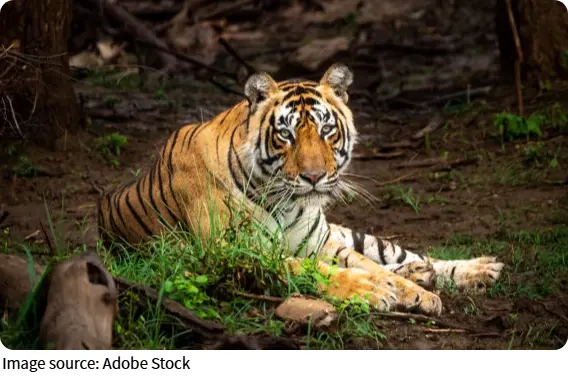
The rainforest floor is dim even during the day, and at night it becomes nearly pitch black. The Sumatran tiger overcomes this with highly developed night vision. Its eyes contain a reflective layer behind the retina, allowing light to bounce back and enhance visibility in low-light conditions.
Uncovering Nature’s Fastest Growing Tissue and Its Biological Mastery
Small wings, strong ties! These birds travel in family groups year after year!
Scientists uncover shocking intelligence in bees—and it changes everything
Scientists finally witness a rare ocean birth—and the teamwork is stunning
From Zebra Stripes to Cow Nose Prints—Nature’s Hidden ID System
Understand the hidden meanings behind tail flicks, pupil changes, and whisker movements!
This means the tiger can detect movement when most animals are effectively blind. It uses darkness as cover, turning nighttime into its most productive hunting period. Instead of competing in daylight, it dominates the hours when silence and shadows take over.
2. Near-Silent Movement
For an animal that can weigh over 100 kilograms, the Sumatran tiger moves with astonishing quietness. Its thick, padded paws act like natural shock absorbers, muffling each step as it glides through leaf litter and tangled undergrowth.
This silence is critical because the tiger relies on ambush rather than endurance. It stalks slowly, often freezing for long periods, before closing in to just a few meters. Only then does it explode into action. The success of this strategy depends entirely on remaining undetected until the final moment.
3. Camouflage Designed for Dense Forests
The Sumatran tiger’s coat is darker and more richly colored than that of other tigers, with narrower, closely spaced stripes. This pattern isn’t random—it’s a highly effective camouflage system.
In the jungle, light filters unevenly through layers of foliage, creating shifting patterns of shadow and brightness. The tiger’s stripes break up its outline, making it almost invisible even at close range. Prey animals scanning the forest often fail to recognize the tiger as a threat until it’s too late. This adaptation is a clear example of how evolution fine-tunes predators to match their environment with remarkable precision.
4. Powerful Swimming Ability
Unlike many land predators, the Sumatran tiger is completely at ease in water. Rivers, swamps, and flooded forest areas are common across its habitat, and this tiger uses them to its advantage.
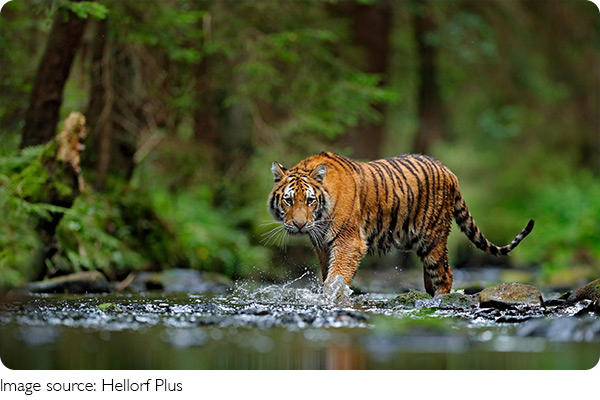
It can swim long distances with ease, aided by slightly webbed paws that improve propulsion. This allows it to cross rivers, expand its territory, and even hunt in aquatic environments. In some cases, it targets fish or water-dwelling prey, showing a level of flexibility uncommon among large carnivores. Water is not a barrier—it’s part of the tiger’s domain.
5. Highly Sensitive Whiskers and Communication
A lesser-known but crucial ability lies in the tiger’s whiskers. These are not just decorative—they are deeply embedded sensory tools connected to nerve endings. They detect subtle air movements and help the tiger judge distances, especially in complete darkness or tight spaces.
This sensitivity allows the tiger to navigate dense vegetation without making noise, maintaining its stealth advantage. In addition, the Sumatran tiger communicates through a range of sounds and signals. Its roar can travel across long distances, marking territory or warning rivals. It also uses softer vocalizations, such as chuffing, for close-range communication—especially between mothers and cubs. Even as a solitary animal, it maintains a complex system of interaction within its environment.
Why These Abilities Matter
Each of these traits reflects a deep connection between the Sumatran tiger and its habitat. This is not a generalist predator—it is a specialist, finely tuned to the rhythms of the rainforest. Its hunting strategies, physical features, and sensory adaptations all work together as a unified system.
However, this specialization also makes it vulnerable. As forests in Sumatra continue to shrink due to human activity, the tiger loses not just space, but the very conditions that make its survival possible. When a species is this precisely adapted, even small environmental changes can have massive consequences.
The Sumatran tiger is a master of silence, shadow, and precision—an animal that has perfected the art of surviving unseen. Yet its greatest challenge today is not prey, but the rapid transformation of its world. To truly appreciate this remarkable predator is to recognize what is at stake.